
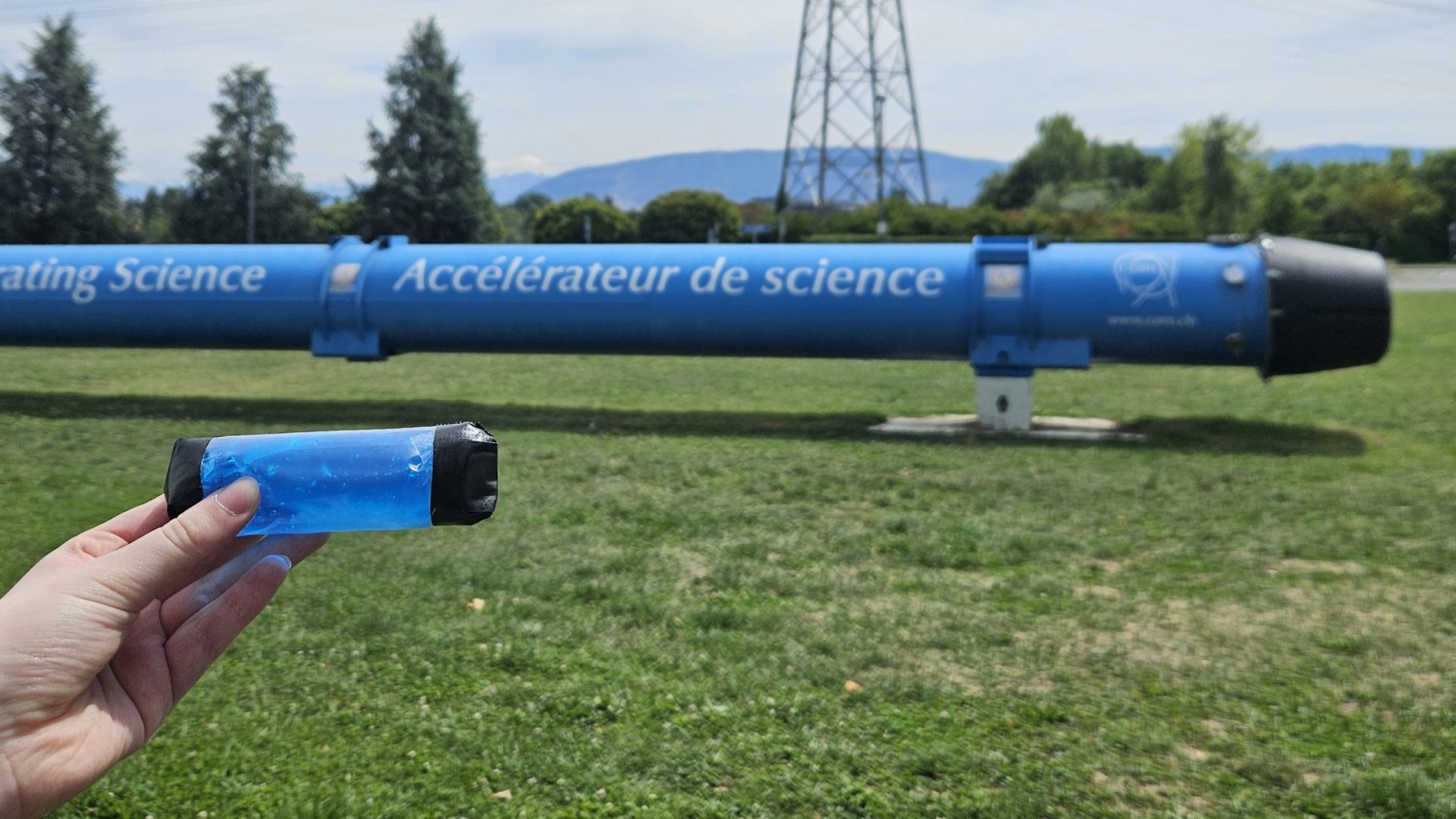
Tinkering Activity: Keeping the LHC cool
Categories
Authors
Description
Below, we introduce the main idea behind a tinkering activity using frugal materials. Tinkering is a playful, hands-on way of exploring a design, where experimenting and learning through iteration take centre stage. It encourages curiosity, supports scientific thinking and opens the door to creative, unexpected solutions. Frugality is all about making the most of simple, readily available materials such as paper or tape. Rather than seeing limited resources as a constraint, frugal approaches treat them as an opportunity for ingenuity and exploration!
In this activity, participants use everyday materials to design and build thermal insulation structures, then test how well they protect a cold pack shaped like one of the LHC’s superconducting dipole magnets. Along the way, they investigate the science of thermal insulation: an everyday phenomenon that is also fundamental to CERN’s ability to operate its accelerators. Through this open-ended challenge, participants experience the iterative process of designing, building, testing and improving, while developing scientific reasoning and creative problem-solving skills. The activity also connects directly to the real engineering challenge of keeping CERN’s accelerators at the extremely low temperatures needed for them to function. You can learn more about how the LHC is kept cool here.
Material list
- Scrap paper
- Tape
- Scissors
- Reusable cold packs
- Infrared (IR) camera
Instructions
Before the activity
- Roll up the reusable cold pack to resemble CERN dipole magnets (see header image)
- Place them in the freezer
During the activity
- Begin with a short warm-up: give each group sheets of paper and access to an IR camera. Let them explore how structuring the paper (folding, layering, etc) affects heat transfer using their own body heat as the source.
- Introduce the concept of frugal innovation: participants will be challenged to solve a design problem using only limited, low-cost materials.
- Distribute one rolled-up cold pack per table along with five sheets of paper, tape and scissors. Measure the initial temperature of the cold pack using the IR camera and note down the value.
- Challenge participants to design an insulation structure that keeps the cold pack as cold as possible for up to 15 minutes, using lessons they learnt from their previous warm-up exercise.
- Encourage participants to test, compare and refine their prototypes using the IR camera for visual feedback.
- After 15 minutes, retrieve the cold pack and measure the final temperature. Compare this value with the initial temperature.
- Optional: take one cold pack out of the freezer as a control. Note down its initial temperature, do not insulate it and re-measure the temperature again after 15 minutes. Compare the control to the cold packs which where insulated.
Ideas for educators
- Emphasise that the paper-only constraint is intentional: restricting material complexity pushes participants toward creativity in structure, layering and folding technique.
- Ask students: Can having fewer resources make us more creative? Imagine that, instead of five sheets of paper and tape, you could choose from twenty different materials. Would that necessarily help you develop a better solution? Could having too many options make the task more difficult?
- Highlight that the first prototype is rarely the best one, and each round of testing provides evidence that can be used to improve the next design. Encourage participants to view every result as feedback rather than a final judgement on their ideas.
- Ask students: When is an unsuccessful attempt scientifically useful? Suppose your first design did not insulate the cold pack well. Was the experiment a failure, or did it produce useful information? What could you learn from it before trying again?
- Be prepared for participants to ask for the “best” or “correct” design at the end. This is a common and valuable teaching moment: use it to highlight that science and engineering rarely have a single definitive answer, and that the value of the activity lies in the process of experimenting, failing and iterating, not in reaching one optimal solution.
- Ask students: Does a scientific problem always have one correct answer? All teams received the same materials and worked toward the same goal, but they produced very different designs. If several designs worked, which one was the “correct” solution?
Related resources
- Check out this video, created for high-school students to discover why the LHC has to be kept at a temperature colder than outer space, and how it manages to stay at such a cold temperature.
- This activity was designed as part of the CERN Summer Student Programme. You can also explore the report written by the Summer Student, which describes the design of the activity and its implementation as a public workshop.