
Cosmic SOS
Categories
Authors
Below is a description of the resource. To download it, please visit: https://doi.org/10.17181/k9sgc-9ns93
Description
Below, we present the main idea, equipment and instructions of a hands-on activity called Cosmic SOS, developed at CERN Science Gateway.
This workshop is designed in the form of an adventure game with a focus on electromagnetic radiation and ionising particles. During this immersive open exploration experience, participants embark on an adventure as members of a spaceship crew. By using different types of detectors and solving various puzzles, they learn about the electromagnetic spectrum and cosmic background radiation.
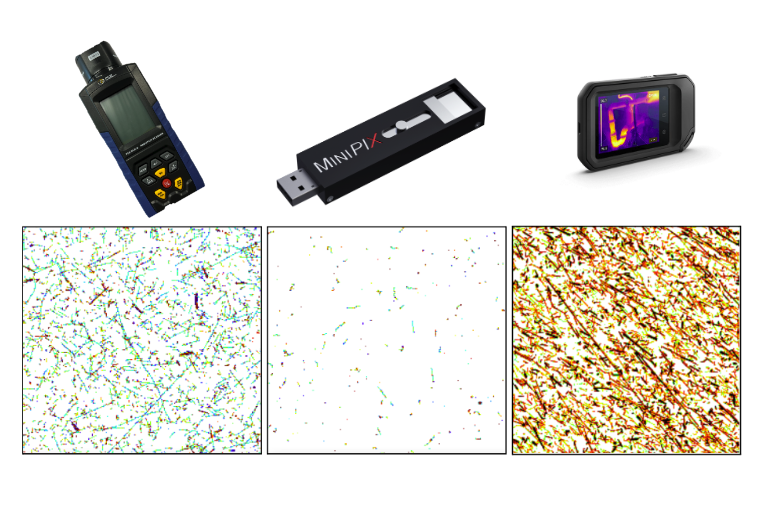
For this activity, a range of detectors is employed, including the MiniPIX EDU detector, a radiation detector based on the MiniPIX silicon pixel technology, developed at CERN and specifically adapted for educational purposes. By allowing the participants to interact with these detectors first-hand and by highlighting their utilisation not only at experiments taking place at CERN, but also on the International Space Station (ISS) or on NASA’s Orion spacecraft, they will gain insight into the broader applications of detectors, which extend beyond the terrestrial laboratories to the frontiers of space exploration.
CERN plays a crucial role in aerospace, thanks to its remarkable technologies, facilities and know-how. You can learn more about CERN and aerospace here.
Material list
The adventure game consists of 6 challenges. Below, we present the equipment needed for each activity. Some activities require simple material, while some others use specialised equipment. The materials are either available for download in this record or linked externally. For links to specific equipment that we used, it may be possible to use alternatives.
In our adventure game, the maximum number of participants is 24, split into 6 groups of 4. We find that 4 participants per group is ideal, so that all members can actively participate.
General material:
- Introduction slides (available for download in this record)
- UV-safe goggles (if you plan to use a UV torch)
- Box with locks (one lock per group) to open the final message
Material per group:
- Worksheet (available for download in this record) + pen
- Organisation boxes to place the materials of challenges 4-6, with serial code to identify the group
- Equipment instructions (available for download in this record)
Challenge 1:
- Circuit (instructions available for download in this record) composed of 2-4 resistors (at least one of which is not connected to the circuit), an LED, a switch (optional), cables and a flat 9V battery
- RGB torch
- UV torch
- IR camera
Challenge 2:
- Prism
- RGB torch
- Fluorescent highlighters of various colours (e.g., yellow, orange, green, blue)
- Optional: UV marker , hide a message on the worksheet
Challenge 3:
- Electromagnetic spectrum cards (available for download in this record)
Challenge 4:
- Geiger counter
- Everyday slightly radioactive objects (e.g., UV beads, rock containing natural thorium)
Challenge 5:
- LEGO pieces (available for download in this record) to make a MiniPIX EDU detector
- LEGO booklet with building instructions (available for download in this record)
Challenge 6:
- MiniPIX TPX detector
- Laptop with Pixet Pro software
- Everyday slightly radioactive objects (e.g., UV beads, rock, balloon with dust)
- Pixel cards (available for download in this record)
TIMEPIX@school
TIMEPIX@school is a new CERN-led educational initiative designed to lower this barrier by bringing Timepix-based detectors, which were originally developed at CERN and are currently used in medical and space applications, into classrooms around the world. You can find out more here.